
Think about the last ten things you bought. Groceries, a new phone, a car service, a flight to Brisbane. In every single one of those transactions, the advertised price was the price. You saw $4.50 for a flat white, and you paid $4.50. The tag on a laptop said $1,799: that's what the bank statement said the next morning.
Now think about buying a home.
You see a guide price of $1,200,000. You spend a weekend imagining your furniture in the living room, you pay for a building inspection, you arrange your finances. Then auction day arrives, and the property sells for $1,380,000. You were $180,000 short. And that's before stamp duty, conveyancing fees, and any number of other costs that don't appear anywhere on the listing, but will appear on your settlement statement. In most Australian states, stamp duty alone on a $1.38M purchase adds another $55,000 or more on top.
The point is this: the gap between what you see on a listing and what you actually pay to own that home is almost always larger than buyers expect, and it has more than one cause. The guide price is one part of the story. The costs that sit invisibly beside it are another. Understanding both is how you go into an auction with a realistic number rather than an optimistic one.
Property may be the only major purchase in most Australians' lives where the advertised price is routinely, significantly lower than what the property will actually sell for - and where substantial additional costs aren't included in the sticker price at all.
This gap between guide and outcome has a well known name: under-quoting. And while underquoting is regulated to varying degrees across Australian states, it remains one of the most persistent information asymmetries in residential property. Agents set a guide price and buyers are expected to understand that the final sale price could land materially higher. What buyers have rarely had access to is hard data on how much higher, and how consistently, for the specific agent marketing the property they want to buy. That's what we set out to measure.

When we first built agent pricing accuracy into Homer, we had to make a choice: what does "accuracy" actually mean? And in a nation of different laws, standards and markets that shift and change over time - what do you actually measure against? A guide price isn't always one number. A guide can be a range ("$1,000,000 to $1,100,000") or a single figure - whatever the format, buyers needed one clear question answered: given this guide, where is the sale likely to land?
As it turned out, answering that question has taken refinement and recognition that accuracy is actually a number of separate things. We've just finished rebuilding the answer, so let's walk through what changed, and how Homer's accuracy measurements affect the grade you'll now see next to an agent's name and the accuracy adjusted range.

The simplest accuracy measure is the one you'd reach for intuitively: take every property an agent has sold, compare the guide price to the sale price, and find the typical Sold-to-Guide gap. We express this as a percentage of the sale price. An agent whose typical gap is 3% is, on average, guiding very close to the market. An agent with a 25% gap on the other hand is systematically off by a significant margin, no matter which way you look at it.
We call this the median absolute error. "Absolute" means we don't care which direction the error goes - whether the sale came in 4% above the guide or 4% below, both count the same. "Median" means we use the middle value rather than the average, so a handful of wildly mispriced properties don't distort the whole picture. This number answers a single question:
"how far off is this agent, typically?"
The previous version of this measure took whichever figure sat at the top of an advertised range, or the single value if there wasn't a range. As we have continued to develop our deep analysis of different markets, agent guiding practices and market conditions, we have now adapted our approach to create cross-market consistency and real-world reliability where we could see it was needed.
The new version of our measurement starts at the bottom of the range.
If an agent advertises $1,000,000 to $1,100,000, Homer now anchors to $1,000,000. A single-value guide like "Offers over $1,100,000" is treated as its own minimum.
From that guide minimum, we then build a 10% guide range window above it. Both guides are then able to be treated and compared in the same way. That window, is what counts as "within guide" for scoring purposes.
Now take those two properties. If they both sold at $1,080,000 - that sale result lands inside the guide window, so it records no error for either.
However, using if one sold at $1,280,000, and the other sold at $820,000 - each would be considered equally innaccurate, using the median absolute error: each falls $180,000 outside the guide window (one below the range floor, one above the range ceiling), so both register a Sold-to-Guide Gap 'miss' -regardless of direction.
Here's the thing though (and this is where most grading systems fall short):
Knowing how far off an agent is, isn't the whole story. You also need to know which way they tend to be off, and whether that direction is consistent.
We call this the median signed error. When a property sells above its guide price, the signed error is positive. When it sells below, it's negative. By finding the median across all an agent's recent sales, we get their characteristic pricing tendency.
An agent with a median signed error of +28% is an example of a systematic under-quoter: their properties typically sell 18 percentage points above the top end of the guide range. On a $1,000,000 - $1,100,000 guide range, that's a predicatable $180,000 gap. That's not random market variation. It's a pattern. And patterns, even uncomfortable ones, are actionable. If you know an agent's guides are consistently 18% below where the market settles, you can plan accordingly.
Real-world sales rarely land on a clean number, and an uncertain or cooling market with longer campaigns can legitimately push a sale slightly below an agent's guide as a result of market movement rather than the accuracy of the agent's pricing. So the new logic also includes a buffer, and it isn't the same size on both sides.
A sale still counts as "within guide" for our overall accuracy measurements if it lands up to 2.5% below the floor, or up to 1% above the top of the 10% window (so up to 11% above the floor in total). Both edges are inclusive, so a sale landing exactly on the boundary counts as a hit.
The two buffers exist for different reasons. The 2.5% allowance at the bottom protects a range of agents who guide reasonably from being considered inaccurate for small, honest dips below their published guide or range minimum: these kind of sales become more common in a softer market and aren't a sign of bad guiding or overall inaccuracy. The 1% allowance at the top protects agents who advertise a genuine range close to that 10% assumption; if their published ceiling sits right where Homer's window ends, a touch of buyer competition pushing the sale just past it shouldn't automatically be read as a miss. Homer is monitoring how that top-edge buffer in particular - and may adapt as necessary to best reflect the real-world accuracy of an agent's guiding practices.
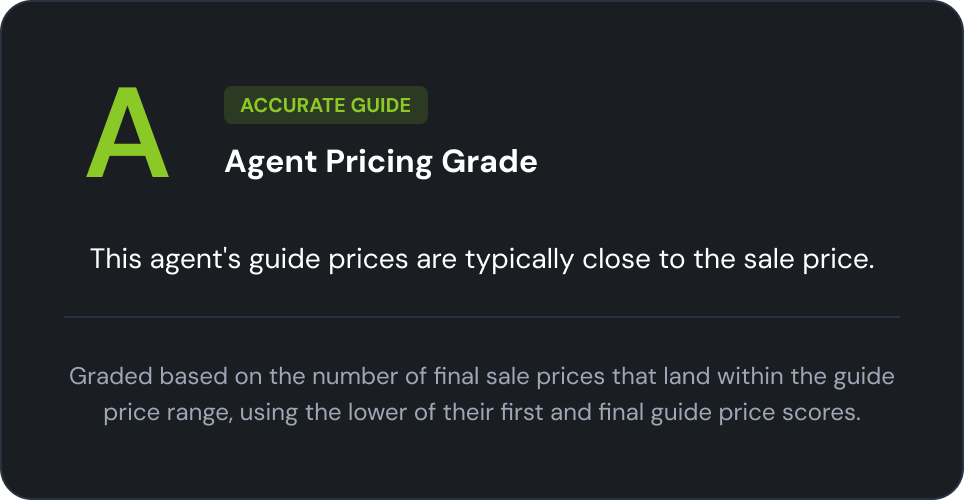
The new grade collapses this into one direct question: of this agent's recent eligible sales, what share landed inside their 0-10% guide range? We call this the hit rate, and it's now the single number behind an agent's grade.
Every agent with at least seven eligible sales in the last six months receives a grade, based on their hit rate. Grades are absolute: they measure how accurate an agent is, not how they compare to peers in their area.
Take two agents with ten recent sales each. Agent A had nine of those ten sales land inside their guide range: a 90% hit rate - almost every sale was within the range. Agent B had 4 of ten land inside theirs: a 40% hit rate. Agent A's guides are giving buyers something to plan around. Agent B's guides are, put simply, much harder to rely on.
Hit rate on its own doesn't tell you whether an agent's misses are consistent or scattered though, and that distinction still matters just as much as it did before. Two agents can share the same 50% hit rate. One might sell everything reliably around 12 to 14% above their guide floor, and the other might swing between selling right on the floor and selling 20% above it with no discernible pattern. Both agent's require further "Review", since half their sales were made outside the guide range, which is where the accuracy adjusted price range and the pricing breakdown then come into play.
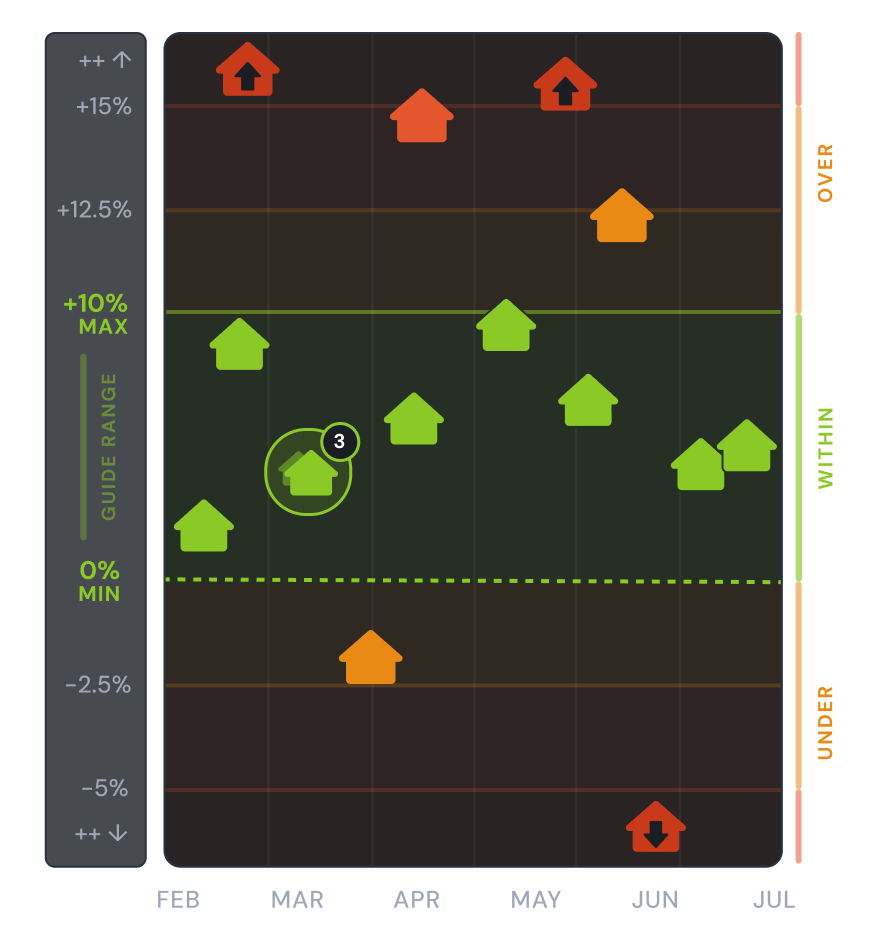
The breakdown shows how spread out an agent's results are, so Homer also shows a simple three-way breakdown of an agent's recent sales. You'll also see this plotted directionally (above, within, or under the guide) and measured over the past 6 months on a chart of an agent's recent sales, so you can see at a glance whether their pricing accuracy is holding steady or changing over time.
We love to see the data, but buying a home can be exhausting and we also understand that sometimes you just want to be told what it means. So we have also introduced the Homer Accuracy Adjusted Guide Price Range. This range takes all of our data, and creates an adjusted guide price for each listing - derived directly from that agent's actual track record.
For every qualifying agent, we look at the full distribution of differences between their guide prices and actual sale prices across their recent eligible sales. We apply the 25th and 75th percentile of that error distribution - the range that captured the middle half of their outcomes - directly to the current guide price:
This means 50% of the agent's recent sales fell within the Accuracy Adjusted Range relative to their guide price.
Take an agent whose sales have typically landed between 10% and 18% above their guide's floor. If they're guiding a minimum of $1,200,000 today, the Accuracy Adjusted Range would show $1,320,000 to $1,416,000, calculated from their own track record.
That's not a valuation, and it's not a prediction. It's what the middle 50% of their recent outcomes looked like, applied to today's guide.
The range is colour-coded based on the agent's accuracy grade - green for Precise or Accurate, amber for Fair, red for Review. The grade and the range work together: one tells you how accurate the agent tends to be in absolute terms, the other tells you in which direction and by how much to adjust.
The range also adapts during a campaign. If the guide hasn't changed, the range uses first-guide accuracy - the most relevant measure of how informative the agent's opening price is. If the guide has been revised, it switches to last-guide accuracy, reflecting how closely their updated pricing tracks outcomes.
The Accuracy Adjusted Range only appears when there's enough data to act on. The agent must have at least 7 eligible sales in the last six months, and their results need to be consistent enough that the range is a useful estimate rather than a shot in the dark (the spread between the 25th and 75th percentile must be 10 percentage points or less, as a wider spread means the agent's pricing is too variable to produce a useful estimate for any individual property).
A sale is only counted as eligible when it has a recorded sale price, a guide that can be resolved to a minimum value, and falls within Homer's sale and listing windows (sold in the last six months, and first listed within the last twelve months). Rentals are excluded, and if the same property is withdrawn and relisted with the same agency within 90 days, it's treated as one continuous campaign and scored from the original guide, not restarted as a fresh listing.
When those conditions aren't met, the range isn't shown; the grade still appears on its own, since a grade only needs a hit rate, while the dollar range needs a distribution tight enough to be worth publishing.
No. A valuation model estimates what a property is worth based on its features, location, and comparable sales. The Accuracy Adjusted Range is a calibration of the agent's guide floor based on how that agent's sales have historically compared to it. The agent has already assessed the property and set a guide; the range tells you how to interpret that guide, given this specific agent's track record.
A valuation asks: what is this property worth?
The Accuracy Adjusted Range asks: given how this agent's sales have compared to their guide floor historically, where is today's guide actually pointing?
They answer different questions. Used together, they give buyers a more complete picture than either alone.
f you're currently in the market, here's the practical upshot.
Treat every guide price as a data point, not a destination. Price guides in Australia have historically been unreliable at best (if they were available at all). For a long time it was expected that properties would sell above it, often significantly. But as markets change, now more than ever the data itself will tell you what to expect from the agent or the property in front of you.
Factor in what the listing price doesn't include. Stamp duty, conveyancing fees, building and pest inspections, mortgage registration, and lender fees all sit on top of the sale price. In most states, stamp duty alone can add 3–5% to your total cost of purchase. Budget for the full acquisition cost, not just the hammer price.
Look at the agent's grade, not just the price. A Precise agent (a 90%+ hit rate against their own guide range) pricing at $1.2M is giving you meaningfully different information than a Review agent (below 60%) at the same guide. The grade tells you how much weight to put on the number.
Where the Accuracy Adjusted Range is shown, use it to anchor your planning. If the accuracy adjusted range is $1,320,000 to $1,416,000 on a $1,200,000 guide minimum, reconsider walking into the auction with $1,200,000 in borrowing capacity and expecting to win. The range is your realistic floor, built not from guesswork, but from the agent's own sales history. If you do want to make an offer anyway - remember to always stick to your budget and be willing to walk away.
The fact that buyers haven't had easy access to this information before wasn't their failure. The data has always existed, in every sale record, every auction result, every comparison between a guide and an outcome. It just needed to be assembled, analysed, and put in front of buyers before they commit. That's what Homer exists to do.
* Homer Agent Accuracy Grades are updated monthly using rolling six-month sale data. Agents require at least ten eligible sales in the last six months to receive a grade. The Homer Accuracy Adjusted Guide Price Range is displayed when the agent meets the 7-sale minimum and the interquartile range of their signed error distribution is 10% or less. All data sourced from Homer's property transaction database.


